Hello, .
Bokeh isn’t a word I use in my photography studies and practice.
But a question about it came up during my Introduction to Photography class, so I figured I’d write about
it.
What’s Bokeh?
The term bokeh frequently comes up during the Introduction to Photography class.
I don’t use the term bokeh, so I didn’t have much to say about it other than I know what the word usually refers to, and when I see it obviously appearing in a certain way, I may incorporate it into the composition or do my best to keep it out.
So I did some research, and in addition to what I already knew, I learned some new stuff, too.
And based on my research and my way of thinking about photography, here’s what I can tell you.
The Etymology (Origin) of the Word
In Western photography, the term “bokeh” was first used in a 1977 issue of Photo Techniques magazine. It is a derivative of a Japanese word meaning “hazy” or “blurred.”
It describes the look of a photograph’s unfocused or unsharp areas, and there is no objective way to measure it.
So, whether bokeh is “good” or “bad” is subjective.
How Do We Use Bokeh?
Compositionally, bokeh appears as parts of an image that are not in focus (unsharp) and separated from what we focus on.
These unsharp areas are more than “simply the
background,” as many of us think of it.
More experienced photographers understand the significance of the background as a practical and psychological consideration in the effectiveness of their photography, so they pay more attention
to it than many photographers.
How Does the Effect Happen?
Bokeh always happens, so It’s not something we need to pursue actively.
Bokeh is nothing more than unfocused light rays recorded in our pictures.
Furthermore, bokeh appears differently depending on aperture size, distance focused on, and lens focal length.
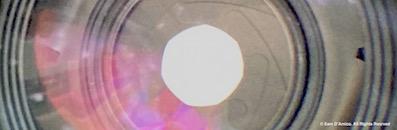
Sometimes, bokeh will contain unsharp shapes like circles or polygons.
And these shapes are caused by patterns of diffraction happening in the lens.
A wide lens opening will produce a more pronounced bokeh, while a smaller lends opening produces a less obvious bokeh.
Is Bokeh the Same As Depth of Field?
In short, no.
However, depth of field will make it more or less noticeable.
An Example of Bokeh
This is a picture I made with a 100mm-300mm 3.5-5.6 zoom lens.
The focal length is 300mm, and the aperture was set at f5.6, the widest aperture available at that focal length.
The effect of bokeh is most noticeable in the lower right of the picture, where the bright white specular highlights of the reflecting water appear as white.
If you click the link, you’ll be brought to the image, where you can scroll around the photo and magnify it.
https://wall-art.samdamico.com/shop-art/art_print_products/white-birch-tree-and-yellow-leaf-in-autumn?product_gallery=54420&product_id=1846310
Bokeh and Composition
We notice bokeh most when we use large aperture
lenses with a shallow depth of field because a good chunk of the image may contain out-of-focus (unsharp) areas.
Lenses with longer (telephoto) or macro focal lengths, mainly when used with their most expansive lens openings, also
make it stand out.
When we use smaller lens openings, out-of-focus areas appear sharper, so the effects of both are less noticeable.
What’s My Opinion of Bokeh?
It’s a word created in 1997 and used by hipsters more than seasoned and professional photographers.
Besides being aware of the background in my image when composing my picture, the term bokeh never
enters my mind during my compositional process.
Also, when critiquing work, I never use the word.
Would I ever use the term when considering a lens to buy?
Nope.
So, it’s not a word I find helpful in my photography studies and practice.
While I have nothing against it, I don’t need to use a trendy word to describe a visual effect that’s been happening since photography started.
Classes are below.
Looking for a camera?
A friend has a Sony Mirrorless Digital Camera, lens,
and a bunch of accessories for sale.
I can vouch that the camera, lens, and accessories are in "Like New" condition.
It seems like an excellent deal.
You can see the details by clicking on the Facebook
Marketplace link below.
https://www.facebook.com/marketplace/item/3942433832662649/?mibextid=6ojiHh
Do you need to learn to use your camera or brush up on some skills and techniques, especially if you want to be ready to take pictures and record those holiday moments?
I've scheduled Introduction to Photography and Getting to Know Your Camera classes.
Since class sizes are limited to five participants, it's a good idea to reserve your spot as soon as possible.
If you need a different schedule, there's always Private Lessons.
Below are more ways to learn photography with me.
The Introduction to Photography class or a series of Private Lessons will help you study and practice to become a photographer who can make the best possible pictures.
By studying and practicing photography with me, you'll learn how to be a better photographer.
More ways to study and practice with me are below.