Hello, .
When considering buying a lens, it helps to have a basic understanding of lenses, how and where to buy a lens, and then choose wisely based on our work.
The lens
of a camera does a few things.
Understanding what a lens does is essential for buying a lens for our camera.
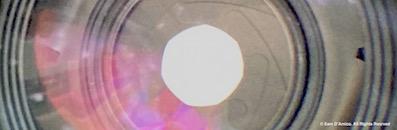
Lenses provide exposure through the variable size of the aperture/f-stop; it gives an angle of view and focuses light on whatever light recording material, film, digital, paper (in the case of an enlarger), etc., we're using.
Specifically, the angle of view describes the focal length.
You'll see a lens described as 28mm,
50mm, 80mm, etc.
Another thing we should know when buying a lens for our camera is that we generally describe lenses as wide-angle (a fish-eye lens is an extremely wide-angle lens), normal, or telephoto.
Those descriptions are general descriptions of a lens' focal length or angle of view that the lens provides.
- A normal lens is considered to be 50mm.
- A wide-angle lens is considered to be anything under 50mm
- A telephoto lens is considered
to be anything over 50mm
The other description for a lens is its aperture or f-stop.
This part of the
description lets us know the most exposure we can get through the lens.
Most lenses have a range of apertures.
We've got fixed focal length lenses, also called "prime lenses" by some photographers.
Then we've got variable focal length lenses, commonly called "zoom lenses."
Often, when changing the focal length (zooming in and out) on a zoom lens, the effective aperture/exposure changes.
When the effective aperture changes, we need to adjust the shutter speed and ISO to make up for the difference in exposure if we want to hold our preferred tonality.
Lenses can cost a lot of money, so budgeting for the purchase is wise.
And remember that we can buy something other than a new lens.
There are used
lenses in excellent condition that you can purchase for less than new prices and save yourself some money.
Additionally, some third-party manufacturers make excellent lenses that are compatible with our cameras and are less costly.
However, I would NEVER buy used lenses from an individual selling their equipment online.
I'd recommend purchasing the lens from a reputable dealer, and only if the lens came with a warranty.
Our local camera store probably has some used lenses in stock, and Adorama, B&H, and KEH are reputable dealers.
When we have a better idea of what to consider when buying a lens for our camera, we can pick the lens that best suits our work.
And if you've got lenses or other eqipment that your struggling to use, then the Introduction to Photography class, the Getting To Know Your Camera class, or a series of private lessons will help you understand your equipment so you can use it effectively.
Whatever you wanna do, I'll be here to help you be a better photographer.
I'll help you be a better photographer—study and practice photography with me.
Currently scheduled classes are below.
Smaller classes mean better learning, so class sizes are limited to 5 participants plus me.
But smaller classes also mean spots fill up quicker, so sign up soon.
And what if the timing doesn't work for you in any of my scheduled group classes? Private in-person or online lessons suited to your schedule are always an option.
And remember, we learn and improve by
doing, so practice making at least one picture daily.
That's all for now; thanks for reading!
Sam