Sam offers in-person and online photography instruction. Call him at 202-531-2344 to see how he can help
you.
These emails come with the intent of helping you be a better photographer.
And if you want more photography stuff to read, there's a place on the interwebs where past emails I wrote are stored. You'll find 'em in the "Newsletter Hub."
Remember, I'd like to know what you want to know about photography. So, If you have any questions, ask by sending an email to me at sam@samdamico.com.
Hello ,
What’s a “Fast Lens”?
It ain’t about how fast a
lens opens and closes. It’s nothing to do with the speed of lenses unless we’re talking about rolling them down a hill to see which one gets across a finish line first.
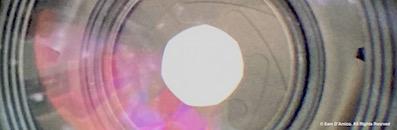
The term fast lens is about the largest aperture/f-stop opening a lens has.
And the bigger the opening of the aperture, the faster the lens.
For example, f/4 is a faster aperture than f/5.6.
But here’s where the fast part comes in. The term fast is a reference to shutter speed.
What Do We Get Out of a Fast Lens? In short, we get faster shutter speeds.
Specifically,
our ability to record motion as static (freezing action) and an increase in the odds of making pictures in low light without blur.
Blur is caused by us holding the camera during an exposure using a shutter speed that’s too slow (unintentional camera movement).
Another fast lens perk is that a bigger lens opening improves autofocus
and metering performance.
Why Would We Want a Fast Lens? Think concerts, nightclubs, dark interiors, anything that’s low light intensity.
Also, think cars driving by, hummingbird wings, a baseball player swinging a bat, a politician dodging questions, and other stuff moving fast.
These things require relatively fast shutter speeds, so we don’t get any unintended blur from handholding the camera or the subject’s movement. Fast lenses help us do that.
Apertures Listed From Fastest to
Slowest f/1.4 f/2.0 f/2.8 f/4.0 f/5.6 f/8.0 f/11.0 f/16.0 f/22.0 f/32.0
So, f/1.4 is faster than f/2.8. And f/1.4 will allow us to make exposures using faster shutter speeds. And using faster shutter speeds will enable us to work with low light intensity and freeze the motion of things that move fast.
And remember, we learn and
become better by doing, so make sure to practice by making at least one picture today.
That’s all for now; thanks for reading!
Sam
Study and practice photography with me.
And if the timing doesn't work for you in any of my scheduled group classes, we can schedule a one-time lesson or a series of in-person or online one-on-one private instruction that cover the same things as any of my group classes.
---Get guidance on going from where you are to where you want to be as a photographer. There's no charge for a follow-up consultation. Just leave your phone number on the form, and I'll call you. Photography Instruction Strategy
Questionnaire.
I look forward to helping you be a better photographer.
Best Regards,
Sam
About Sam
Sam D'Amico, a professional photographer and photography
instructor, helps anyone who wants to be a better photographer.
He'll work with his students to increase their understanding of camera operation, composition, light, and lighting.
Sam started working as a professional photographer
in the mid-1980s.
Most notably, from 1992 to 1997, while working as a freelance photographer, he photographed over 500 assignments for the New York Times.
Additionally, Sam received awards for his work while
exhibiting his photographs in shows.
Sam began teaching photography professionally in 1998 through the Highland Park, N.J. recreation department.
In 2002 Sam moved to Washington, D.C., and began teaching at the accredited Washington
School of Photography in Bethesda, Md.
It was in 2003 that Sam developed his curriculum and started teaching classes in Washington, D.C.
In 2018 and 2022, the Sam D'Amico Photography Classes were voted the "Best of DC" art class by the
readers of the Washington City Paper.
Many photography teachers spend a lot of time teaching about DSLRs and rules of composition that create homogenized, rigid photographs.
On the other
hand, Sam teaches about camera operation, thought process, and the individual photographer's visual communication intent.
This approach to teaching allows his students to use ANY camera (yes, even the camera on their phone) and break free of the rules of composition.
Approaching the creative process this way allows for fluid and spontaneous photographs unique to the photographer creating them.
Sam encourages his students to find their ways as photographers.
He
instills the skills in his students that result in creative, engaging, and unique compositions that reflect the photographer's intended one-of-a-kind visual expression.