There’s Nothing Like Lens Condensation That’ll Put a Damper on Making Photographs
Published: Thu, 07/20/23
Sam offers in-person and online photography instruction. Call him at 202-531-2344 to see how he can help
you.
These emails come with the intent of helping you be a better photographer.
And if you want more photography stuff to read, there's a place on the interwebs where past emails I wrote are stored. You'll find 'em in the "Newsletter Hub."
Remember, I'd like to know what you want to know about photography. So, If you have any questions, ask by sending an email to me at sam@samdamico.com.
Hello ,
It’s a hot and muggy summer in DC. We’ve been getting daily thunderstorms, which I like being in, but the rain isn’t the only thing that dampens our equipment. It’s the kind of weather that could get us some lens condensation.
The first time this happened to one of my lenses, I had no idea what was going on. I panicked. I thought my lens would be damaged and I’d need to get a new lens. But luckily, there was a more experienced photographer who set my mind at
ease.
Since lenses are glass, they’re fair game for condensation.
And if our lenses have condensation, we’ve gotta put off making pictures until it clears up. Or, better yet, do our best to prevent the condensation from happening in the first place.
What is Lens Condensation?
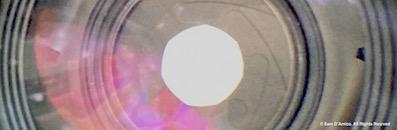
Lens condensation is when drops of water form on the lens’ surface and make it “foggy.” Most of the time, this happens on the outside of the lens, but it can happen on the inside too. And if it persists, it can cause mold, corrosion, and other not-so-good
stuff.
How Does Lens Condensation Happen?
Condensation happens when there’s a significant change in the temperature of the lens glass and the air surrounding it. It’s the same thing that happens to a
cold bottle of our preferred beverage on a hot day, except it’s our lens and not enjoyable.
For example,
Suppose we’re making pictures outside in hot weather and move into a significantly colder space like an air-conditioned building. In that case, we’ll probably get lens condensation. The same thing could happen when going from cold to hot.
What Can We Do To Avoid Lens
Condensation?
If we wanna avoid lens fog, we should do what we can to prevent the lens from going too quickly from one extreme temperature or another. It’s best to transition the lens slowly between different humidity and
temperature spaces.
In other words, we’ve gotta give the lens time to acclimate to the new temperature. It
shouldn’t take that long, maybe around ten minutes, but we’ve gotta pay attention when changing our environment.
Humidity’s got a lot to do with this, too. We want our equipment to be constantly dry. If we’ve got a good quality camera bag, we can put silica bags close to our equipment; they’ll soak up moisture and help keep our equipment dry.
And, of course, if we notice any moisture forming on any of our equipment, wiping it to get the moisture off is a good idea.
If We Get Lens Condensation, What Can We Do?
The smartest thing to do is to wait for it to go away on its own. It should take about 10 minutes, but it could be longer. We can move the process along by wiping off the lens with a good-quality lens cloth once in a while. We’ll briefly get a clear lens, and we could probably make a picture or two before the fog comes back.
If we’ve got filters on the lens, take ’em off. Sometimes, it’s just the filters that get fogged up. And if we’ve got more than one
filter on, separate ’em all and wipe each off.
And if you’re curious and feelin' a bit adventurous, why not
take pictures while the condensation’s happening? Sure, some details in the image will get lost, but so what? Who knows? We might like the effect it has on what we’re photographing.
If we get a lot of condensation on the inside lens, the best we can do is to keep the lens with silica bags and wait. Give it a few days or a week. If the lens still has condensation after that time, we should get it to a repair shop to remove it.
---Get guidance on going from where you are to where you want to be as a photographer. There's no charge for a follow-up consultation. Just leave your phone number on the form, and I'll call you. Photography Instruction Strategy
Questionnaire.
I look forward to helping you be a better photographer.
Best Regards,
Sam
About Sam
Sam D'Amico, a professional photographer and photography
instructor, helps anyone who wants to be a better photographer.
He'll work with his students to increase their understanding of camera operation, composition, light, and lighting.
Sam started working as a professional photographer
in the mid-1980s.
Most notably, from 1992 to 1997, while working as a freelance photographer, he photographed over 500 assignments for the New York Times.
Additionally, Sam received awards for his work while
exhibiting his photographs in shows.
Sam began teaching photography professionally in 1998 through the Highland Park, N.J. recreation department.
In 2002 Sam moved to Washington, D.C., and began teaching at the accredited Washington
School of Photography in Bethesda, Md.
It was in 2003 that Sam developed his curriculum and started teaching classes in Washington, D.C.
In 2018 and 2022, the Sam D'Amico Photography Classes were voted the "Best of DC" art class by the
readers of the Washington City Paper.
Many photography teachers spend a lot of time teaching about DSLRs and rules of composition that create homogenized, rigid photographs.
On the other
hand, Sam teaches about camera operation, thought process, and the individual photographer's visual communication intent.
This approach to teaching allows his students to use ANY camera (yes, even the camera on their phone) and break free of the rules of composition.
Approaching the creative process this way allows for fluid and spontaneous photographs unique to the photographer creating them.
Sam encourages his students to find their ways as photographers.
He
instills the skills in his students that result in creative, engaging, and unique compositions that reflect the photographer's intended one-of-a-kind visual expression.