There’s an Opening in Our Lens That Does Some Interesting Stuff to Compositions
Published: Sat, 07/15/23
Sam offers in-person and online photography instruction. Call him at 202-531-2344 to see how he can help
you.
These emails come with the intent of helping you be a better photographer.
And if you have any questions about photography or anything photography-related you'd like me to write about, let me know by sending an email to me at sam@samdamico.com.
Hello ,
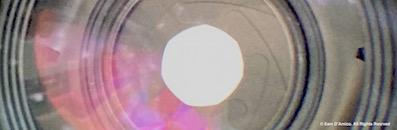
There’s an opening in our lens that does some important stuff when it comes to our compositions.
We can make the opening bigger or smaller.
We can think of it as the pupil in our eye that automatically increases or decreases in size in response to more or less intense light sources. Except with our aperture, we can change it in aperture priority or manual exposure modes. And If we've got our camera set on an automatic exposure mode, our camera
picks the aperture for us.
We can call it an aperture, or we can call it an f-stop. But
I prefer to call it an aperture and describe whatever aperture I've picked as an f-number or f-stop.
We describe an aperture as f/2.8, f/4, f/5.6, f/8, etc.; these numbers describe whether the size is
bigger or smaller.
Aperture controls the compositional elements of tonality and depth of field.
What's an Aperture
Basically, as stated, an aperture is an opening in a lens that can be made bigger or smaller. It's also an exposure component that controls
tonality along with shutter speed.
What’s an F-Stop?
An f-stop, or f-number, represents the relative aperture size of a lens.
And, in terms of exposure and tonality control, the same
f-number/aperture gives us the same exposure and tonality control across all lenses.
In short, f-stops are a consistent way to describe the amount of exposure we'll get through our lens apertures.
How Aperture Affects Tonality
I, think of tonality as how bright or dark a photograph is.
Our aperture is a component of exposure, and exposure can be increased or decreased. And as we increase or decrease exposure, so goes tonality.
In other words, increasing or decreasing exposure will make our picture brighter or darker. And the brightness and
darkness in our picture are the tonality.
How Aperture Affects Depth of Field
I think of the depth of field as where sharpness appears to start and where sharpness appears to stop in front of and the back of the distance focused on. And I think of the depth of field as being deep or shallow.
The size of our aperture influences the depth of field.
As we increase and decrease the size of the aperture, our depth of field gets shallower or deeper.
This is the stuff we cover during the Introduction to Photography class.
And if the scheduling doesn't work for the Introduction To Photography class. In that case, we can schedule a series of In-Person or Online One-on-One Private Instruction that cover the same things as the Introduction To Photography Class.
---Get guidance on going from where you are to where you want to be as a photographer. There's no charge for a follow-up consultation. Just leave your phone number on the form, and I'll call you. Photography Instruction Strategy
Questionnaire.
I look forward to helping you be a better photographer.
Best Regards,
Sam
About Sam
Sam D'Amico, a professional photographer and photography
instructor, helps anyone who wants to be a better photographer.
He'll work with his students to increase their understanding of camera operation, composition, light, and lighting.
Sam started working as a professional photographer
in the mid-1980s.
Most notably, from 1992 to 1997, while working as a freelance photographer, he photographed over 500 assignments for the New York Times.
Additionally, Sam received awards for his work while
exhibiting his photographs in shows.
Sam began teaching photography professionally in 1998 through the Highland Park, N.J. recreation department.
In 2002 Sam moved to Washington, D.C., and began teaching at the accredited Washington
School of Photography in Bethesda, Md.
It was in 2003 that Sam developed his curriculum and started teaching classes in Washington, D.C.
In 2018 and 2022, the Sam D'Amico Photography Classes were voted the "Best of DC" art class by the
readers of the Washington City Paper.
Many photography teachers spend a lot of time teaching about DSLRs and rules of composition that create homogenized, rigid photographs.
On the other
hand, Sam teaches about camera operation, thought process, and the individual photographer's visual communication intent.
This approach to teaching allows his students to use ANY camera (yes, even the camera on their phone) and break free of the rules of composition.
Approaching the creative process this way allows for fluid and spontaneous photographs unique to the photographer creating them.
Sam encourages his students to find their ways as photographers.
He
instills the skills in his students that result in creative, engaging, and unique compositions that reflect the photographer's intended one-of-a-kind visual expression.