We work in manual exposure mode during the Introduction To Photography class.
We learn to use aperture (f-stop), shutter speed, and ISO to control our pictures’ tonality and other visual elements to create intentional compositions.
But
let’s talk about aperture because, during the class, one thing that comes up is that the aperture numbers don’t seem to play nicely like the other numbers do.
I mean that the numbers dealing with shutter speed and aperture double and halve
when changing them in full stop increments.
Participants in the class usually say something like, "The aperture numbers don’t make sense!"
For example, a one-stop change in shutter speed would be from 1/500 (one five-hundredth of a second) to 1/1000 (one-one thousandth of a second).
And a one-stop change in ISO would be from 100 to 200.
On the other hand, a one-stop change in aperture would be f8 to f11.
On face value, those aperture numbers don't seem to make sense when doubling and halving, do they?
Well, they do.
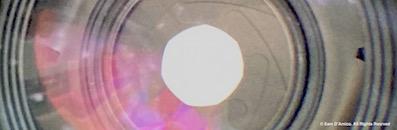
But before I go on, I’ve got to tell you all I need to know about aperture: a one-stop change in aperture doubles or halves the
picture’s tonality and influences the depth of field.
In other words, knowing and remembering what I’m about to tell you about the science behind aperture numbers doesn’t help me in my practical photography studies and
practice.
But since the photographers in my classes ask about this frequently, I figured you might be curious, too.
So, here we go down the rabbit hole of aperture number science.
F-stops are a series of
geometrically sequenced numbers.
And they’re sequenced by the powers of the square root of 2.
So when we see an f-stop number, it’s representing a fraction.
Specifically, an aperture opening is a fraction
of the focal length of our lens.
So, if we’re using a 100mm lens set to f8, that means the size of the aperture is one-eighth of the lens’s focal length.
And using the same 100mm lens at f11 means the opening of the lens is one-eleventh of the lens’s focal length.
And since one-eleventh (1/11) is smaller than one-eighth (1/8), we can see how this makes sense.
This stuff applies to ALL lenses regardless of focal length.
And there’s no need to understand or remember this unless this understanding helps us make better pictures.
I remember I had to know this stuff for a photography test during a class I took at a community college.
But after that, I forgot the math and science behind apertures.
Because although that tidbit of lens science might help me pass a test, It doesn’t help me with practical “in-the-field” camera operation and composition.
What matters to me is what the aperture does regarding controlling tonality (and depth of field) during practical camera operation and composition.
So, that’s the best I can do to explain the science behind the aperture size numbers.
But if you want to learn about the practical application of aperture and the other camera settings we use to create intentionally composed photographs, I’ve got plenty more to teach.
Introduction To Photography class start dates are today at noon and Sunday, July 9.
Spaces are limited to five.
So, reserve your spot now.